Corinne Thomas
Principal AI Consultant & Founder


Published on 9 February 2026 in Agency Insights, AI & Sales Tech
Scottish businesses are navigating a significant shift in how work gets done. AI adoption is accelerating because the barrier to entry has dropped dramatically. You no longer need technical expertise or substantial budgets to experiment with AI tools that can save time, reduce costs, and improve decision-making.
The question facing mid-sized businesses and social impact organisations across Scotland is no longer “should we adopt AI?” but “how do we adopt AI safely, strategically, and in ways that align with our values?”
This guide draws on insights from Scottish AI experts, real case studies from businesses that have successfully implemented AI, and practical frameworks you can apply to your own organisation.
Key Takeaways:
In this article:
AI performance is doubling every six to seven months, compared to the traditional two-year cycle of Moore’s Law for computing power. The AI market was valued at $638 billion in 2024 and is projected to reach $3.7 trillion by 2034.
Consider these adoption speeds: Netflix took 18 years to reach 100 million users. Facebook took four and a half years. YouTube took 18 months. ChatGPT? Two months.
What changed isn’t just the technology itself, but the interface. You no longer need to learn complex software or write code. You talk to these tools in plain language.
For Scottish businesses – particularly those in rural areas or traditional industries – the question is whether you’re building capability now or watching competitors gain ground? The good news is that for mid-sized Scottish SMEs and social impact organisations, AI implementation doesn’t require massive budgets or technical teams.
AI adoption doesn’t look the same across every sector or organisation. Different companies, departments, and industries are moving at different speeds – what experts call a “jagged edge” of adoption. Some businesses are making measurable progress. Others are stuck in uncertainty about where to start. Most are working through the practical realities of implementation whilst trying to maintain business as usual.
The Scottish Government is responding with a new AI Scotland programme launching in March 2026 and a refreshed national AI strategy aimed at ensuring AI-driven growth benefits communities across society, not just those with existing advantages.
But government programmes can only provide infrastructure. The real work happens inside your organisation. Read on for some essential tips to get started.

Manufacturing: reducing waste through better inventory management
Norscot is a 60-person manufacturing SME in the Scottish Highlands, making windows, doors and structural timber frame kits. They faced a common challenge: disconnected databases and inefficient inventory systems were creating waste.
With no AI or software development skills in-house, they worked with the Data Lab and the Scottish Manufacturing Digital Hub to implement a six-month demonstrator project. The key to success was focusing on team engagement from the start.
“You need to share all the benefits with your team. They’re going to buy in to this new system because it’s a new way to doing things,” says Carla Resendes Villasenor, Product Development Manager at Norscot.
Their advice to other businesses: identify which processes you could make more efficient and which data you have but aren’t using. These two questions apply to every business, regardless of sector.
Other Scottish AI adoption examples
Healthcare innovation: Seluna, a Glasgow-based medtech company, uses AI to diagnose sleep apnoea in children. Clinical studies that once required extensive manual analysis now happen faster, reducing diagnosis wait times from months to weeks.
Infrastructure resilience: SSE uses AI to monitor complex assets in real time. When storms knock out power, AI predicts where failures are likely, enabling faster recovery.
Care delivery: Time for You Care, an Edinburgh-based at-home care provider, uses AI for route optimisation. This reduces carbon footprint, cuts administrative burden, and enables them to service more care packages with the same resources. The cost efficiencies go directly to frontline staff pay.

To start AI adoption successfully, focus on three foundations: Skills (build AI literacy across your organisation), Culture (make it safe to experiment with tools), and Data (ensure it’s accessible and trustworthy). Begin by identifying which processes could be more efficient, creating a simple AI policy covering acceptable tools and data boundaries, and focusing on one high-impact area before scaling.
This AI implementation framework works for organisations of any size – from small businesses experimenting with free tools to established SMEs investing in structured programmes.
Skills: Invest in AI literacy across your organisation. Focus on continuous learning rather than one-off training, as the technology evolves rapidly. Everyone needs to understand best practices and safe use, even if they don’t need technical expertise.
Culture: Make it safe for people to experiment with AI tools and share what they learn. When people have freedom to experiment with proper support, fear disappears, and they can decide for themselves where AI fits in their work.
Data: Ensure your data is accessible, structured, and trustworthy. Good data input creates good AI output. Simple practices like consistent tagging and clear file descriptions make data AI-ready.
A practical checklist for getting started
Define your starting point:
Start with leadership and strategy:
Look for the right first projects:
Focus on one area first: Find one area where AI can make a tangible difference, implement it properly, measure the results, then scale.
Common generative AI tools in use today
General purpose: ChatGPT (most popular among small businesses), Microsoft Copilot (particularly for organisations already using Microsoft products), Google Gemini, and Perplexity (especially for online research tasks).
Specialised tools: Fireflies for meeting transcription, Gamma for presentation creation, Google AI Studio to build AI-apps.
Choose based on your existing technology ecosystem rather than adopting technology because it’s popular.
Key risks to manage
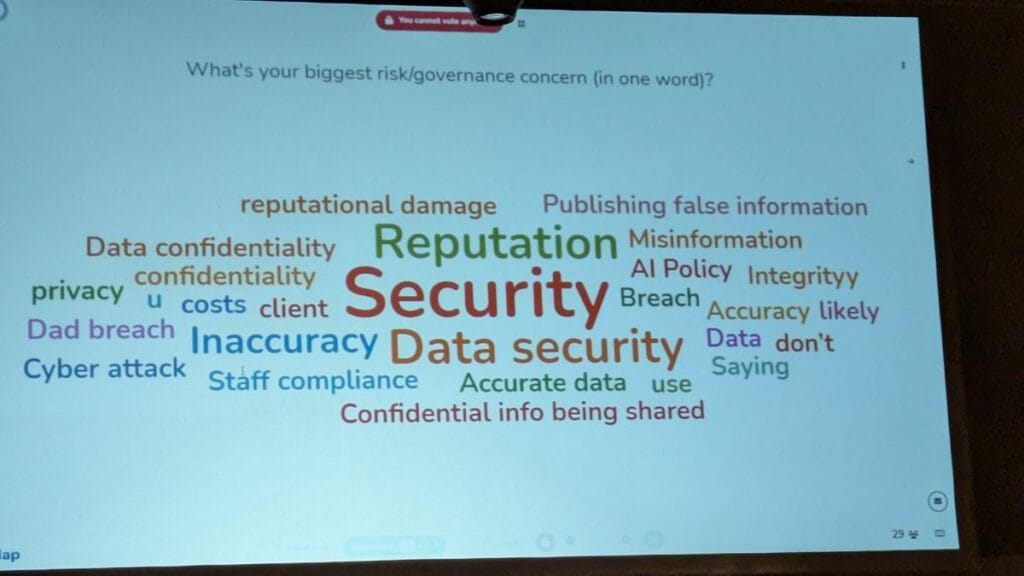
The main risks of AI adoption for SMEs include cybersecurity threats, data privacy concerns, ethical implications of AI-driven decisions, environmental impact of data centres, and difficulty validating AI outputs. Mitigate these risks by establishing clear policies on tool use, data sharing, and human oversight before implementation begins.
Cybersecurity threats have increased – AI helps businesses automate tasks, but also helps threat actors automate attacks.
Data privacy concerns are significant. Establish clear policies on what your team can use, what platforms they have access to, and what data they’re allowed to input into public AI tools.
Ethical implications require consideration. Should you be doing what you’re planning? Who will be impacted? Ethical frameworks exist to guide you through these questions before implementation.
Validation challenges are real. Unlike traditional software, where there’s often a clear yes/no answer, AI can generate responses you hadn’t considered. How do you validate and trust what it’s producing?
Environmental impact matters. Look at what tools are utilising green data centres. Consider prompt engineering to use fewer resources for better outputs.
Available support in Scotland
Government programmes: AI Scotland (launching March 2026), Skills Development Scotland’s My World of Work platform (5,000+ free courses), Scottish AI Alliance resources.
Enterprise support: Highlands and Islands Enterprise, Scottish Enterprise and the Data Lab, all provide structured support for businesses at different stages of adoption.
Specialist consultancies: Organisations offering AI training and implementation support specifically for Scottish businesses.
How are Scottish businesses currently using AI?
Scottish businesses are using AI across multiple sectors. Manufacturing companies like Norscot Joinery use AI for inventory management and waste reduction. Healthcare organisations like Saluna use AI for faster diagnostics. Energy companies like SSE use AI for predictive maintenance. Care providers like UCARE use AI for route optimisation.
What are the main risks of AI adoption for SMEs?
Key risks include cybersecurity threats, data privacy concerns, ethical implications of AI-driven decisions, environmental impact of data centres, and difficulty validating AI outputs. Establish clear policies on tool use, data sharing, and human oversight before implementation.
Where can Scottish businesses get support for AI adoption?
Support is available through AI Scotland programme (launching March 2026), Skills Development Scotland’s My World of Work platform (5,000+ free courses), Scottish AI Alliance, Highlands and Islands Enterprise, Scottish Enterprise, the Data Lab, and Scottish Manufacturing Digital Hub. Specialist consultancies also offer structured AI adoption programmes.
What should be the first step in AI adoption?
Start by identifying which processes could be more efficient and which data you have but aren’t currently using. Define why you want to use AI before selecting tools, create a simple AI policy, and focus on one high-impact area first. Many businesses benefit from an initial assessment to clarify priorities.
How long does AI implementation take for mid-sized businesses?
Implementation timelines vary significantly. Norscot’s pilot project took six months. Simple automation tasks can show results in weeks, while full integration across workflows typically takes 6-12 months. Starting small and scaling based on results is more effective than attempting full transformation immediately.
What does AI adoption cost for SMEs?
AI adoption costs vary significantly. Starting with free tools like ChatGPT costs nothing beyond staff time. Structured implementation programmes range from £2,000-£10,000 for initial assessment and training. Custom AI development projects for specific business needs typically cost £20,000-£100,000+. Most Scottish SMEs begin with low-cost experimentation before committing to larger investments.
Do I need technical staff to adopt AI?
No. Many AI tools are designed for non-technical users. Norscot Joinery successfully implemented AI without any in-house AI expertise by partnering with the Data Lab and Scottish Manufacturing Digital Hub. The key is understanding your business problem clearly, then working with experts who can translate that into technical solutions.
What’s the difference between AI adoption and AI implementation?
AI adoption refers to beginning to use AI tools and building organisational capability. AI implementation is the process of integrating AI into specific workflows and systems. Most businesses start with adoption (experimenting with tools like ChatGPT) before moving to implementation (embedding AI into core business processes).
At Ethical Sales, we help organisations adopt AI in ways that align with their values and business goals. We’ve guided businesses through this journey since early 2024 – from initial assessment through to confident implementation.
We work with senior leaders in established organisations who face the pressure to modernise whilst maintaining governance, culture, and credibility. Our approach combines practical diagnostics with structured training and capability building, helping you identify where AI can deliver real value and how to implement it safely.
If you’re leading an organisation with £2-50M turnover and need support navigating AI adoption in a defensible, controlled way, let’s talk.
Book a meeting to discuss your specific needs and explore how we can support your journey.
About this article
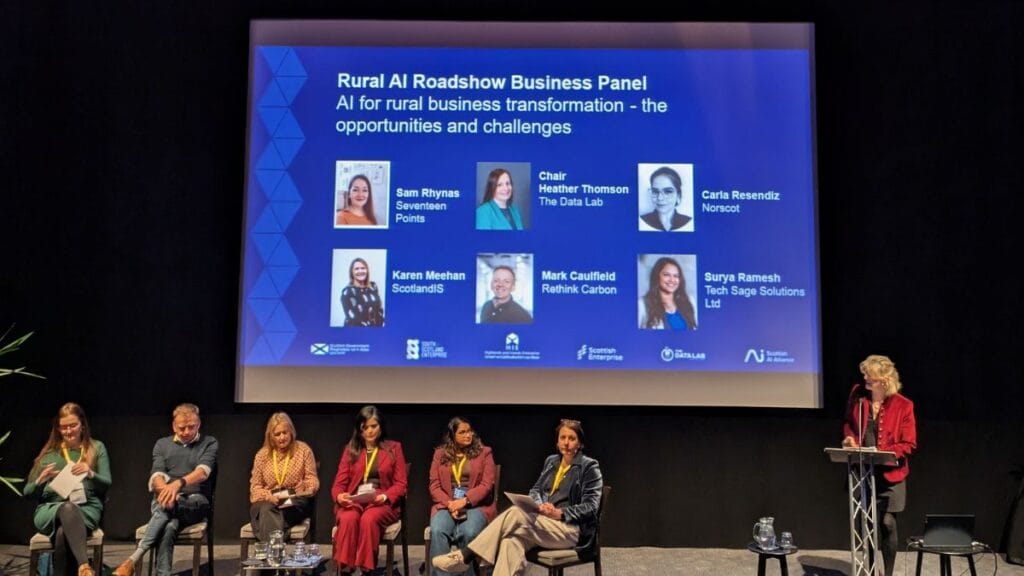
The insights in this article were gathered from Corinne Thomas, our Founder and Principal AI Consultant who attended the Rural AI Roadshow, which took place in Inverness on 27th January 2026. The event brought together 46 business leaders from across the Scottish Highlands and Islands to explore practical AI adoption strategies for businesses in Scotland.
The roadshow was organised bythe Data Lab, with support from Highlands and Islands Enterprise, Skills Development Scotland, and the Scottish AI Alliance. Speakers included Chris Boyland from the Scottish Government, Heather Thompson (Chief Executive, the Data Lab), Carla Resendes Villasenor (Norscot Joinery), Karen Meekin (ScotlandIS), Sam Ryness (17 Points), Surya Ramesh (independent data consultant), and Robbie MacIsaac (Bellrock Technology).
The event is part of a broader AI Scotland initiative launching in March 2026, designed to provide coordinated support for Scottish businesses adopting AI technologies.